Overview
How McDonald's Chile combined contextual AI, cross-device planning and attention measurement to learn what makes every screen perform.
THE CLIENT
An iconic brand learning from every screen.
McDonald's is one of the world's most recognizable brands, with a constant need to connect different products, cultural moments and audiences through relevant communication.
In Chile, McDonald's and ShowHeroes developed a series of video campaigns across Connected TV and online video. The partnership covered three distinct moments: breakfast occasions, a football-focused promotion and the launch of the Stranger Things Happy Meal.
Rather than treating each campaign as an isolated activation, the teams used them to build a growing body of knowledge about the environments, screens and creative formats that generate the strongest attention and response.
THE CHALLENGE
Reach was only the starting point.
In a fragmented video ecosystem, delivering impressions does not necessarily mean that people are paying attention.
McDonald's Chile wanted to understand what happened after an ad was served:
- Which contexts were best at sustaining attention?
- What role should CTV and online video play?
- Which creative formats worked best on each screen?
- How could exposure be transformed into consideration and action?
The challenge was to move beyond conventional delivery metrics and establish a repeatable model for measuring the quality of every exposure.
THE QUESTION BEHIND THE BRIEF
“Which combination of context, screen and creative turns video exposure into meaningful attention?”
THE STRATEGY
A cross-device model powered by contextual intelligence.
ShowHeroes designed a video strategy combining Connected TV and online video, using Semantic Hero AI to match each campaign with relevant, brand-safe environments.
The activation assigned a specific role to each screen:
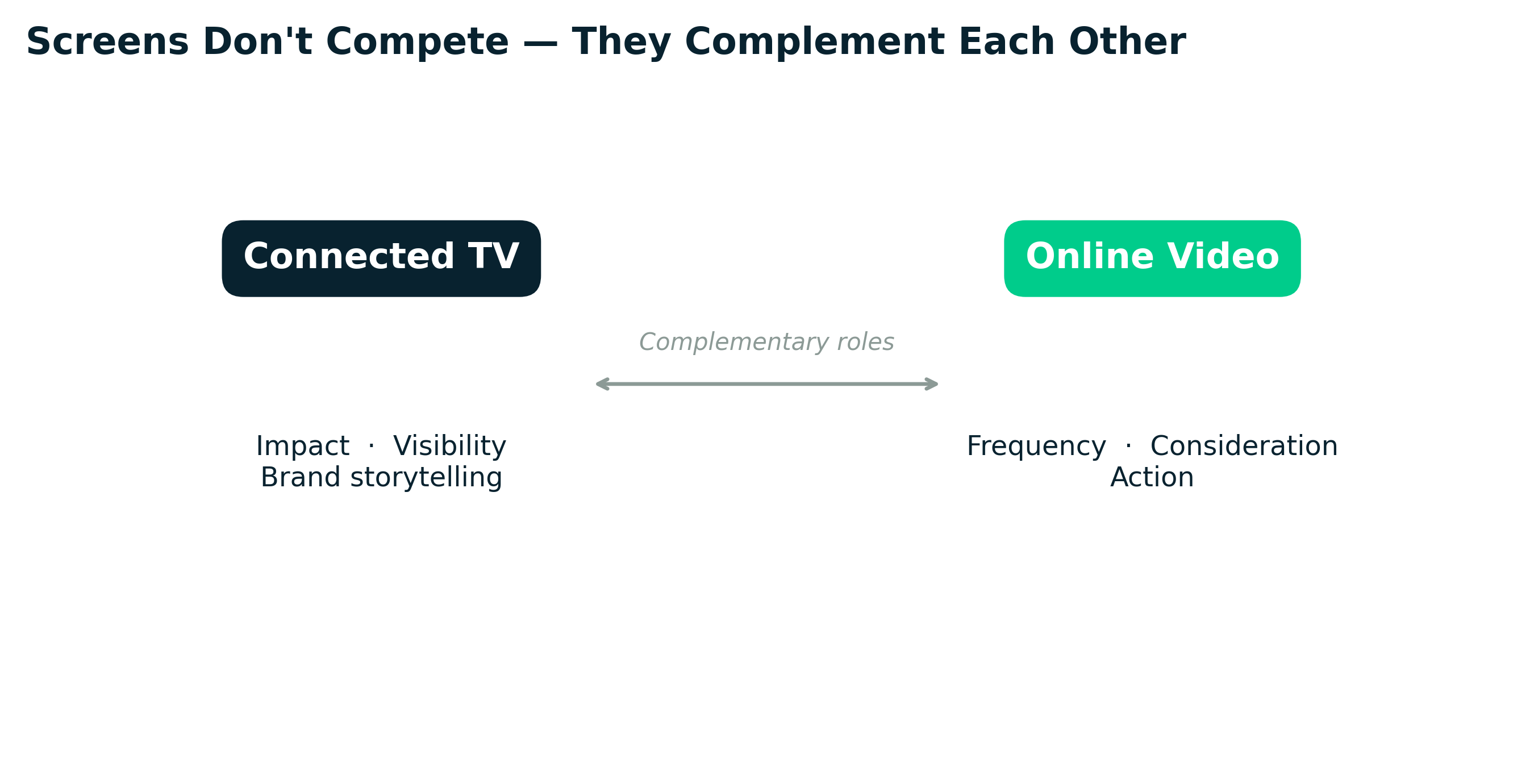
- Connected TV delivered impact, visibility and brand storytelling in an immersive, large-screen environment.
- Online video reinforced frequency, consideration and action through more agile viewing moments.
- Semantic Hero AI identified contextual categories and media environments with the strongest affinity and attention potential.
- SH Attention Index measured the quality of exposure beyond impressions, VTR and clicks.
Instead of optimizing only at the end of each campaign, this framework transformed every activation into a new source of learning.
THE MEASUREMENT FRAMEWORK
From media delivery to attention intelligence.
Campaign performance was evaluated through traditional media indicators and ShowHeroes' proprietary attention measurement.
The framework connected four dimensions:
- Delivery: impressions and reach.
- Viewing quality: VTR and video completion.
- Attention: attentive seconds per thousand impressions, expressed as APM.
- Action: click-through rate and interaction signals.
This allowed McDonald's Chile to identify not only whether a campaign was viewed, but which combination of context and creative was most effective at holding attention.
THREE CAMPAIGNS. ONE LEARNING SYSTEM.
Breakfast
Owning an everyday consumption moment.
The Breakfast campaign sought to transform the start of the day into an opportunity for attention and interaction on the open web.
Semantic Hero AI prioritized contexts with a greater capacity for visual attention and retention, while a 17-second L-Shape format kept the brand continuously visible.
Performance
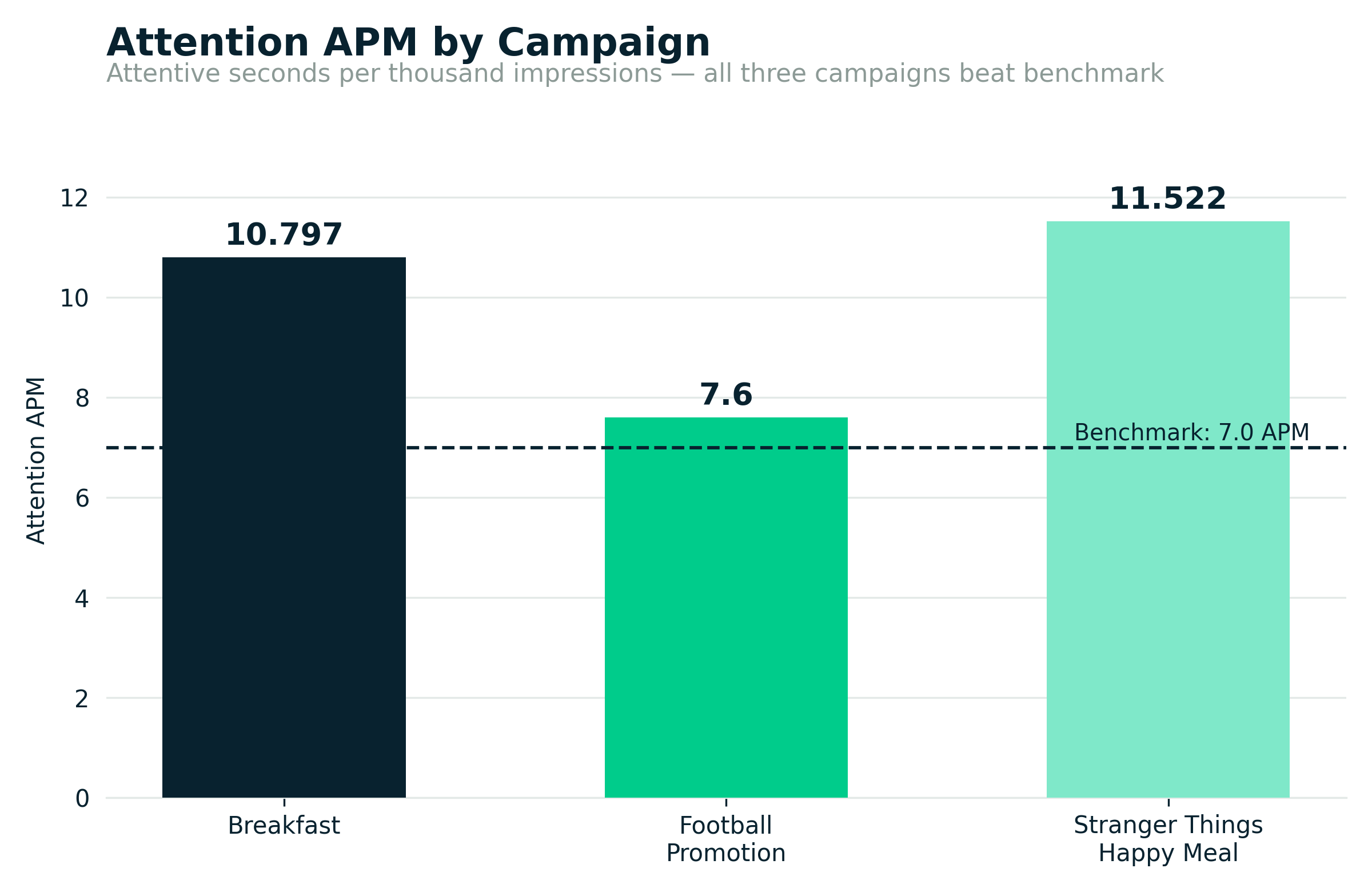
- 10.797 Attention APM.
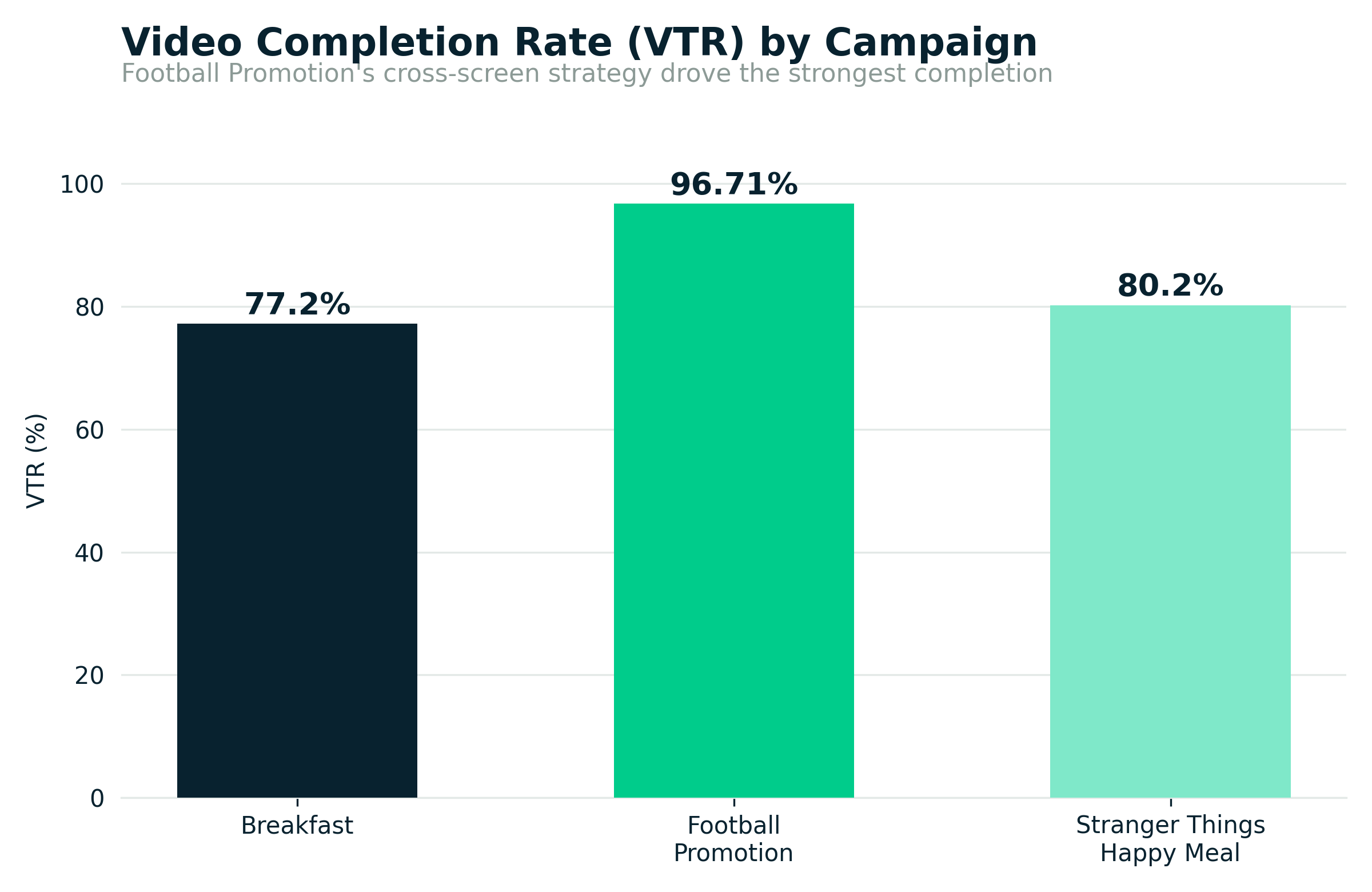
- 77.20% VTR.
- 0.34% CTR.
- 54% attention lift versus the stated benchmark.
What it revealed
Gaming and Technology generated strong viewing volume and visual retention, while Sports emerged as the most effective context for driving interaction.
The L-Shape format also reinforced brand visibility throughout the viewing experience.
Football Promotion
Connecting awareness and action across screens.
The football-focused campaign aimed to maximize reach, attention and action while understanding the user journey around a major cultural moment.
A cross-screen strategy used CTV for impact and message-building, while online video reinforced frequency and generated clicks.
Performance
- 7.6 Attention APM across devices.
- 96.71% VTR.
- 0.53% CTR.
- 165% CTR lift versus the stated benchmark.
What it revealed
CTV and online video performed complementary roles. The large screen created visibility and impact, while online video helped maintain frequency and encourage action.
Stranger Things Happy Meal
Turning cultural relevance into sustained attention.
For the Stranger Things Happy Meal, the objective was to connect with audiences already interested in technology, entertainment and pop culture, while measuring exposure quality beyond a completed view.
The campaign used a 15-second interactive rich-media format supported by contextual targeting.
Performance
- 11.522 Attention APM across devices.
- 80.20% VTR.
- 0.13% CTR.
- 64% attention lift versus the stated benchmark.
What it revealed
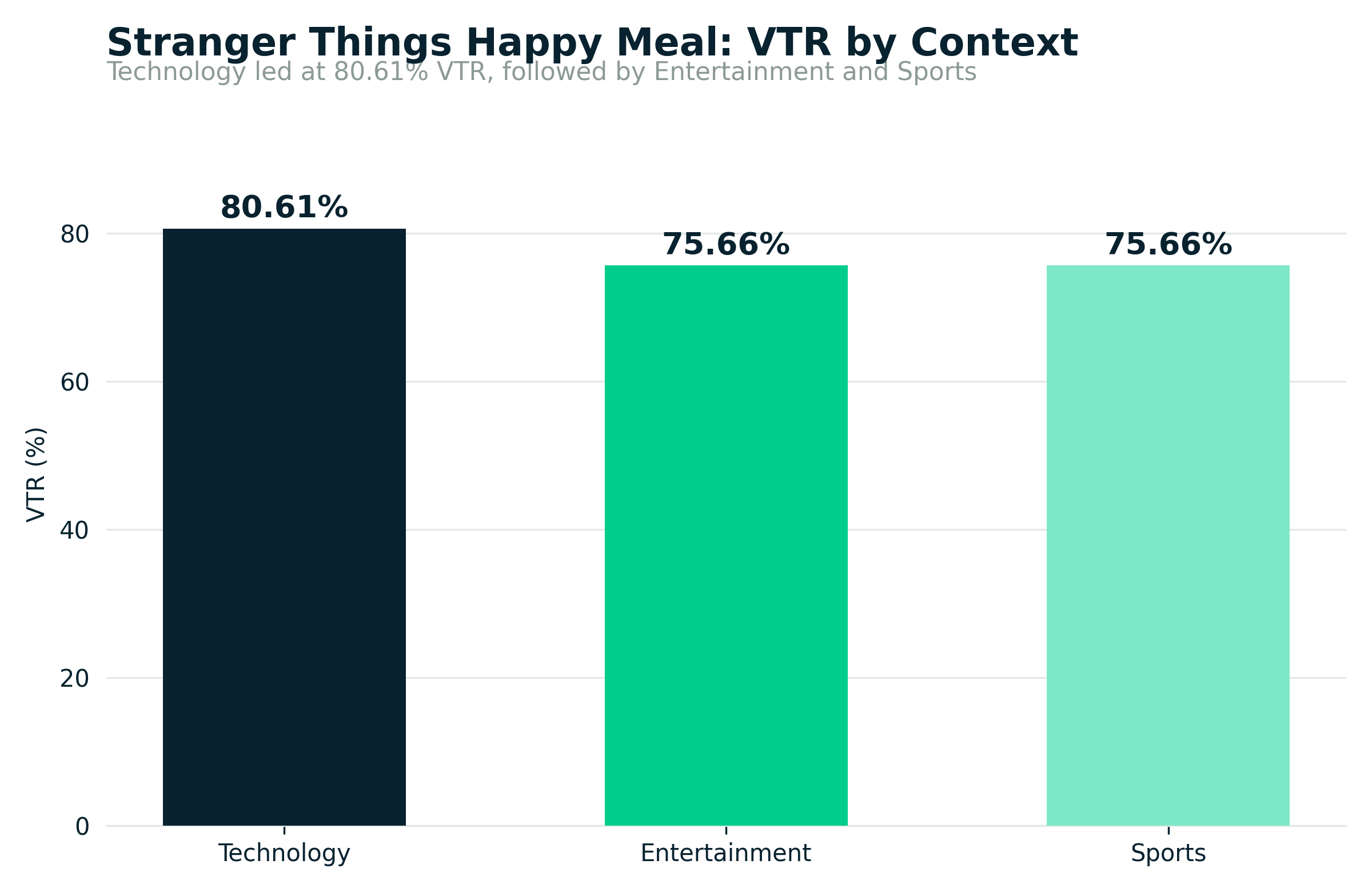
Technology was the strongest contextual category, reaching an 80.61% VTR. Entertainment and Sports followed with a 75.66% VTR, expanding the campaign into environments with high audience receptivity.
The interactive format sustained attention while creating a more dynamic experience connected to the Stranger Things universe.
THE RESULTS
Above delivery metrics — and rich with actionable insight.
Across the three activations, ShowHeroes helped McDonald's Chile identify how context, screen and creative work together.
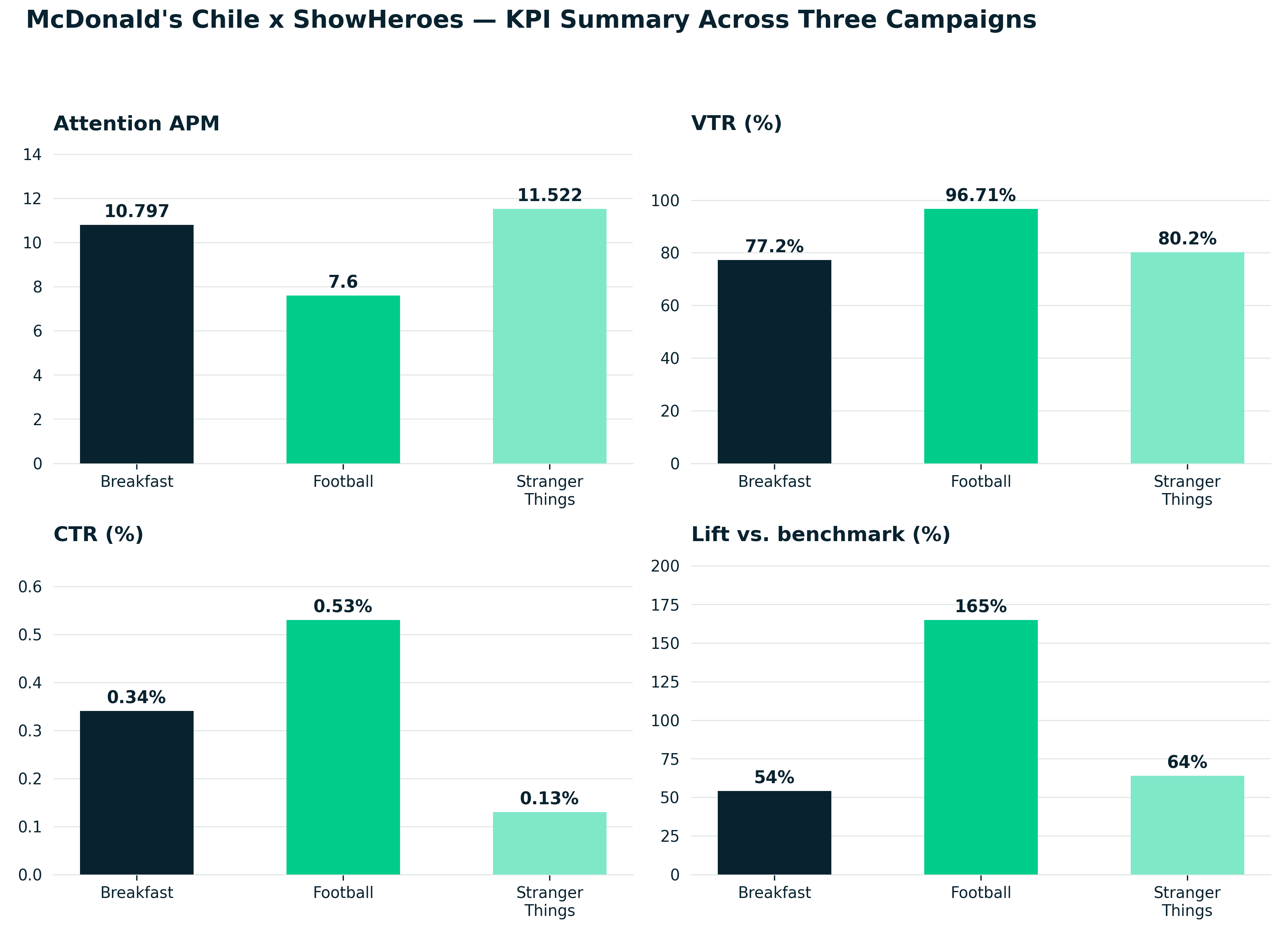
- Up to 64% attention lift — the strongest activation recorded an Attention APM of 11.522 against a benchmark of 7.0.
- Up to 96.71% VTR — the cross-screen football campaign delivered the highest video completion result.
- Up to 0.53% CTR — the strongest action result represented a 165% improvement over the campaign benchmark of 0.20%.
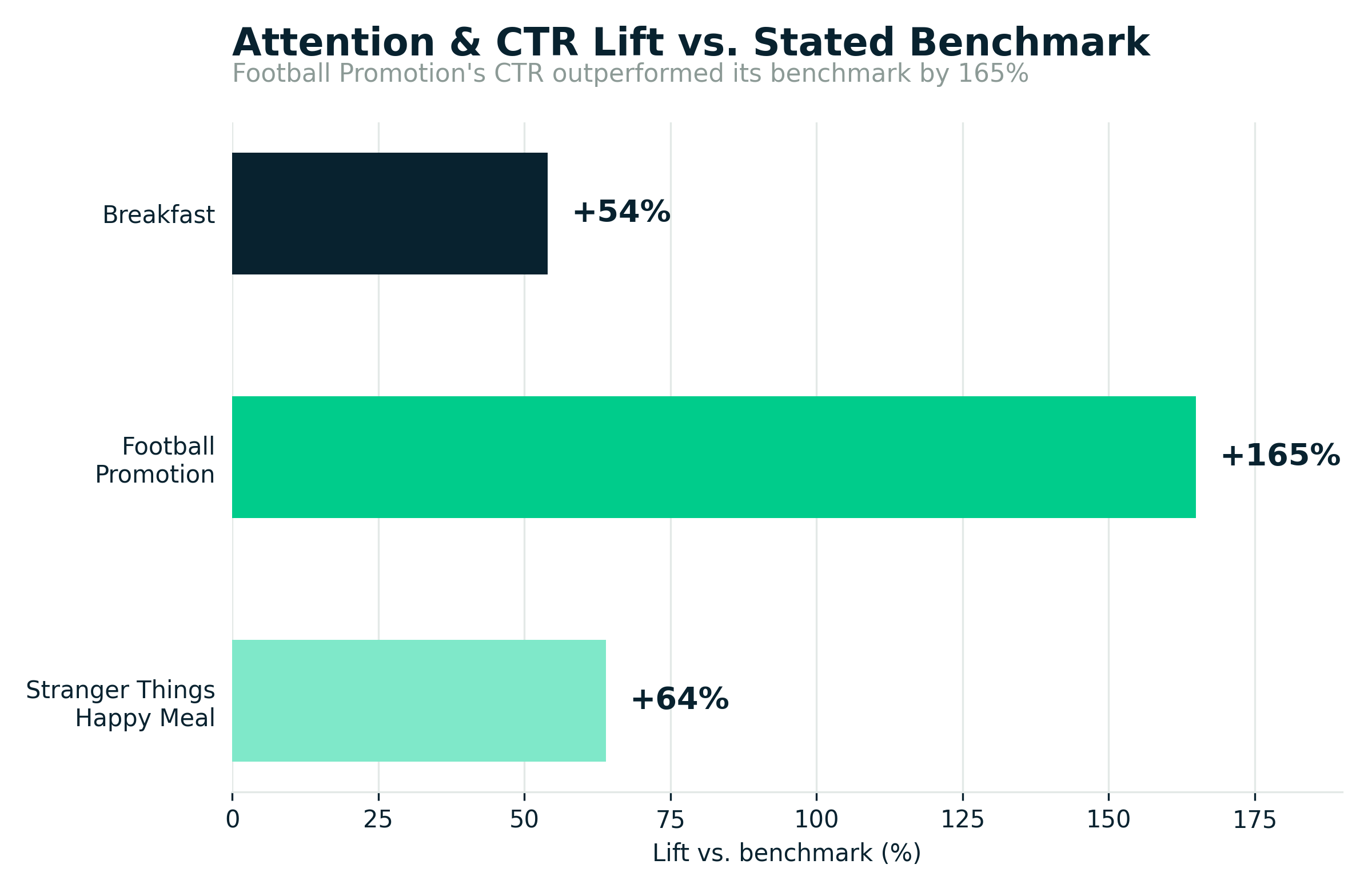
A growing proprietary benchmark: every campaign added new evidence about McDonald's audiences, messages, screens and best-performing contexts.
WHAT WE LEARNED
Four lessons for the next activation.
Context has different jobs.
Gaming and Technology demonstrated a strong capacity to sustain viewing and retention, making them valuable environments for awareness and brand-building.
Sports showed a greater propensity to generate interaction, strengthening its role in consideration and action-oriented campaigns.
Screens do not compete — they complement one another.
CTV builds visibility, impact and attention. Online video reinforces frequency, consideration and response. The strongest planning model gives each screen a specific role within the same journey.
Creative format shapes attention.
L-Shape formats can reinforce constant brand visibility. Interactive online-video formats encourage consideration, while longer CTV videos provide more room for storytelling and brand construction.
Continuous measurement creates a competitive advantage.
The value of the partnership is not limited to improving one campaign. Each activation contributes to a McDonald's-specific benchmark that can guide future planning, creative development and media optimization.
LOOKING AHEAD
From individual campaigns to a repeatable attention model.
By linking contextual relevance, cross-device planning and proprietary attention measurement, McDonald's Chile and ShowHeroes can move from measuring media delivery to understanding real communication impact.
The next step is to apply the same learning system from the beginning of every campaign: testing creative alternatives, defining the role of each screen and optimizing contextual categories according to the desired business objective.
The result is a more efficient video model in which every campaign not only performs, but also teaches the brand how to perform better next time.